

Surabaya, Kemendikdasmen — The Ministry of Primary and Secondary Education (Kemendikdasmen) continues to demonstrate its commitment to strengthening equitable and quality education services throughout Indonesia.
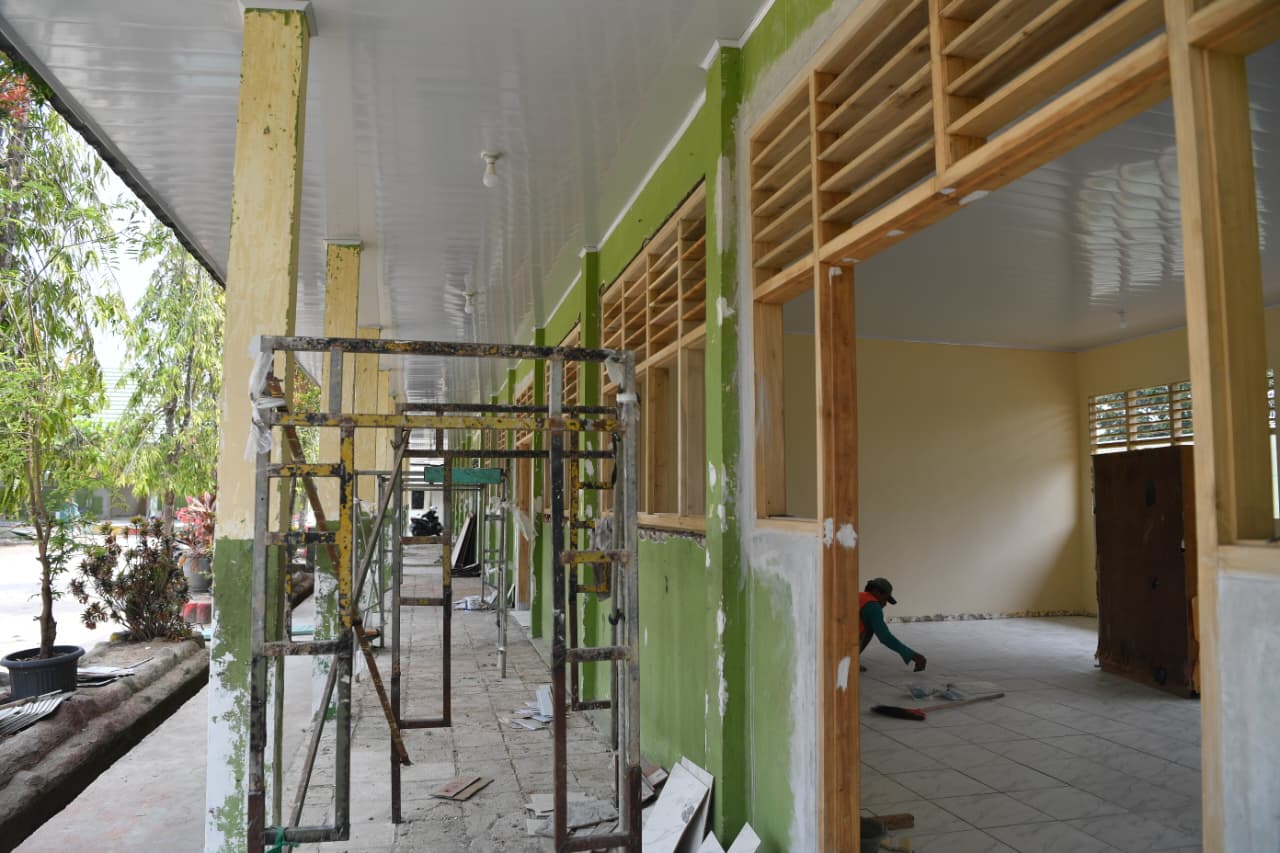
One of the strategic steps that is now a priority program is the Revitalization of Educational Units, an innovative approach to improving educational facilities and infrastructure that not only focuses on improving the physical quality of schools, but also aims to encourage community participation and drive the local economy.
This program is implemented using a self-management model, namely that educational units together with the community are directly involved in the construction and procurement process, without having to go through a large contractor mechanism.
This approach provides space for communities to actively participate in the school development process in their respective areas. This involvement is expected to strengthen the community's sense of belonging to the educational unit, thereby creating a collaborative climate between the school and its surrounding community.
Driving Force of Village Economy
The Director of Early Childhood Education (PAUD), Nia Nurhasanah, explained that the revitalization of educational units using a self-managed pattern is not only about building infrastructure, but also a holistic approach that places education at the center of community development.
"Through self-management, schools can purchase building materials directly from local hardware stores, allowing government aid funds to directly reach local businesses. Local builders, craftsmen, and laborers are also involved, so this program serves as an economic stimulus for the community," Nia said in Surabaya on Friday (July 4).
The procurement of goods and services around the school contributes to a healthy economic cycle. Building supply stores, sand and stone suppliers, transportation services, and even food stalls near the project site benefit.
"It's not just physical development, but there's a multiplier effect that's directly felt by the community," he added.
Build a School, Build a Spirit of Mutual Cooperation
This program also promotes the spirit of mutual cooperation, a long-standing value of Indonesian society. Communities, along with school committees and educators, are involved in the planning, implementation, and oversight of development. They are not merely spectators but also agents of change.
"When parents help paint classrooms or build school fences, a sense of ownership develops. This is crucial for maintaining the sustainability of the facilities that have been built. Schools belong to everyone, not just the government's responsibility," said a PAUD principal in Pati Regency, Central Java, who participated in the initial revitalization program.
This revitalization program aims to address gaps in the quality and adequacy of educational facilities and infrastructure, particularly in the 3T (Underdeveloped, Frontier, and Outermost) regions and areas with inadequate educational facilities. The central government provides direct funding to educational institutions designated as program targets, with strict technical guidelines and oversight.
Transparent and Accountable
To maintain accountability, educational institutions receiving assistance are required to develop activity plans and budgets approved by the management team, including supervisors from the education office and the community. All processes, from planning and purchasing to financial reporting, are conducted transparently and accessible to stakeholders.
The Ministry of Primary and Secondary Education also provides technical assistance and training for principals, operators, and committees to ensure they understand the procedures for managing aid funds in accordance with regulations. The involvement of regional supervisors and facilitators is a crucial part of the program's field control system.
With a self-managed approach that prioritizes local participation and independence, the Education Unit Revitalization Program is a clear illustration that educational transformation does not always have to come from the top down, but can also grow from the grassroots, from the community itself.
This program demonstrates that education is a shared responsibility. When communities are involved, schools are cared for, and local economies grow, the government's mission to achieve quality, inclusive, and equitable education can be achieved more quickly and sustainably.
"This is not just physical development, but also mental development, a spirit of togetherness, and the future of our children," concluded Nia Nurhasanah.
Accountability and Transparency
Sutanto, Senior Expert Widyaprada of the Directorate General of Early Childhood Education, Primary, and Secondary Education, called for full commitment from all early childhood education units receiving government assistance through the Early Childhood Education Unit Revitalization Program. He emphasized the importance of implementing this program with the principles of accountability, transparency, eligibility, quality, and quantity at every stage of its implementation.
In his statement, Sutanto reminded that the success of the revitalization program depends heavily on close collaboration between stakeholders, transparency in budget management, and high integrity in providing educational services.
"Implement this revitalization program with full integrity, in accordance with the established Technical Instructions and Implementation Guidelines. We will not tolerate any deviation, whether from a technical, administrative, or financial management perspective. Zero tolerance for violations is our primary principle," he stressed.
He also encouraged continued intensive communication between PAUD units and the District/City Education Office, PAUD Directorate, university facilitators, and the BBPMP/BPMP. He believes that openness to challenges and issues in the field is key to the program's success.
"Never assume you can solve a problem on your own. Immediately communicate any obstacles to the relevant parties so they can be mitigated and the best solution can be found," he emphasized.
Sutanto also emphasized the crucial role of the Education Unit Program Implementers (P2SP) as the spearhead of revitalization implementation on the ground. He stated that P2SPs must work with sincerity, high motivation, and integrity to deliver tangible and sustainable results for education units in the regions.
"Make the results of this revitalization an educational monument, the best legacy that will be remembered by our children and grandchildren in the future," he added.
Concluding his message, Sutanto invited all parties to continue to maintain the spirit of mutual cooperation, strengthen shared commitment, and ensure that every step in the revitalization of PAUD units truly supports the future of Indonesian children.
"Let us face the future of our children's education with a collaborative spirit, full of integrity, and relentless hard work," he concluded.
The Early Childhood Education Revitalization Program is a strategic step by the government to improve the quality of early childhood education services comprehensively, encompassing institutional management, the learning environment, and the active participation of the community and local government. (Eko B Harsono/Editors: Rayhan, Denty A.)