




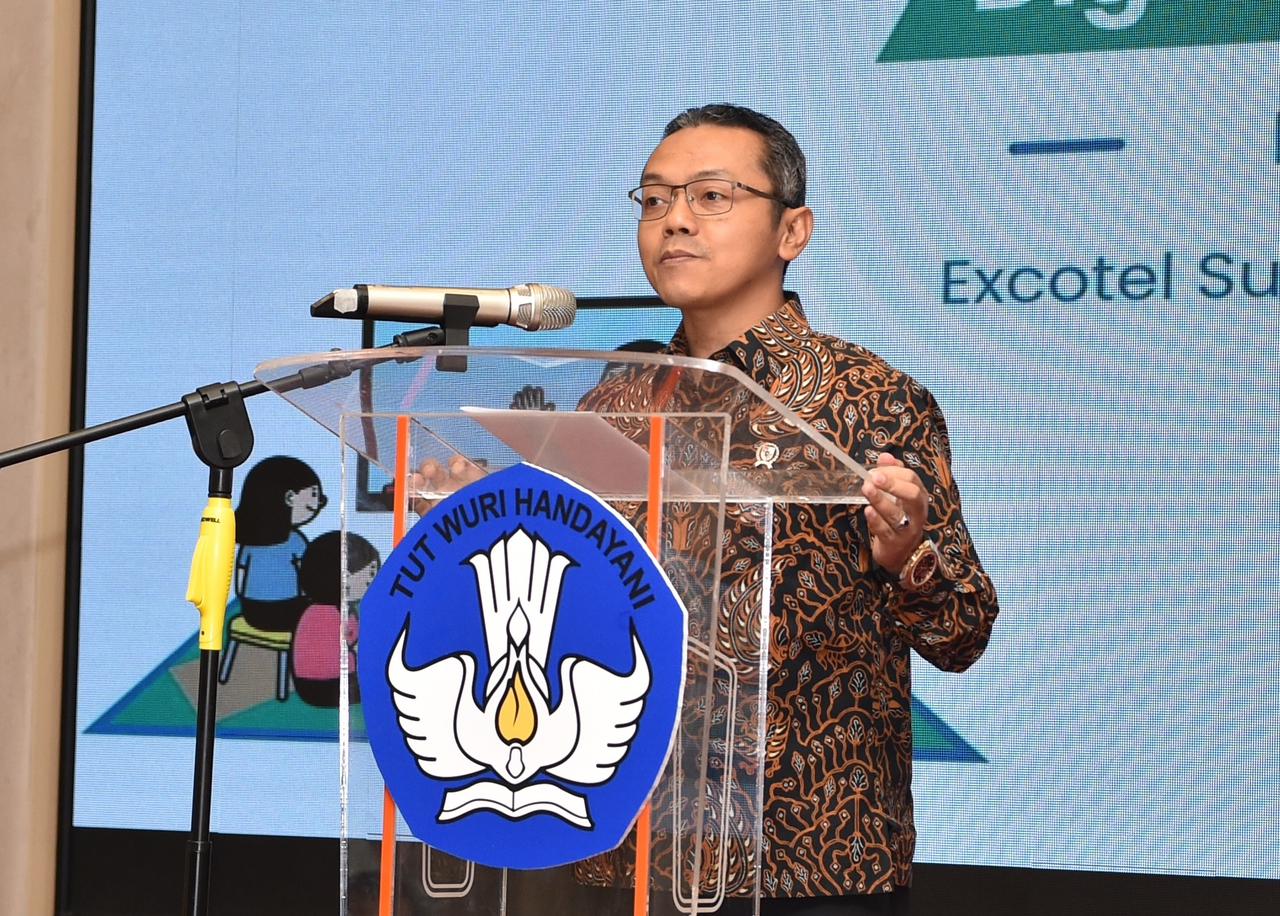
Surabaya, Kemendikdasmen — The Ministry of Primary and Secondary Education (Kemendikdasmen) continues to strengthen its commitment to providing quality education for all through the Digitalization of Learning program. Deputy Minister of Primary and Secondary Education (Wamendikdasmen), Fajar Riza Ul Haq, emphasized that this step is part of President Prabowo Subianto's policy to accelerate equitable education quality across Indonesia.
"From the beginning, we have been asked to promote the digitalization of learning, one way being through the distribution of Interactive Flat Panels (IFPs). With this technology, children throughout Indonesia will be able to access the same learning content as children in big cities," said Deputy Minister Fajar in his remarks at the Digitalization of Learning Technical Guidance event in Surabaya on Wednesday (September 17).
Deputy Minister Fajar explained that one of the main problems in Indonesian education is the disparity in quality between regions. The presence of the IFP is believed to help reduce this gap. "The key is providing the same learning content for all Indonesian children. However, its success still depends on the digital pedagogical competence of teachers. These devices must not be merely decorative. Teachers still play a key role in enlivening the classroom atmosphere," he emphasized.
By 2025, the government will distribute 288,000 IFP units, including more than 64,000 for early childhood education (PAUD) units, as part of the revitalization of education infrastructure. These devices not only display images, sound, and video but also enable more interactive and enjoyable learning. According to Deputy Minister Fajar, the presence of technology should make children more active, stimulated, and motivated in the learning process.
However, Deputy Minister Fajar warned of the risks of excessive screen use. "According to research, the maximum screen time for children is one hour. IFP shouldn't cause children to become lazy about movement. Physical interaction and motor skills must still be encouraged," he explained.
He also emphasized that digital technology such as gadgets and the internet is like a double-edged sword, it can provide benefits if used correctly, but has the potential to cause negative impacts if not accompanied.
Meanwhile, Mareta Wahyuni, Chair of the Implementation Committee for the Digitalization of Learning Technical Guidance, stated in her report that the program is being implemented based on Presidential Instruction Number 7 of 2025 concerning the Revitalization of Educational Units and the Implementation of Digitalization of Learning. "Digitalization of Learning is not just about providing devices, but rather building a comprehensive digital-based learning ecosystem, encompassing technology, content availability, learning environment support, and pedagogical strategies," she explained.
The Directorate of Early Childhood Education (PAUD) has prepared a capacity building scheme for IFP recipient units, including 1) Offline technical guidance for 2,160 PAUD units; 2) Offline technical guidance with 34 UPTs for 3,240 PAUD units; 3) Online technical guidance for 58,791 PAUD units; and 4) Webinars with 10 themes related to IFP utilization, interactive digital content, and device maintenance.
By August 2025, 150 resource persons had been trained as national facilitators. This week, technical guidance was provided simultaneously to 720 early childhood education (PAUD) units receiving IFP in Surabaya, Bogor, and Padang, with 120 participants attending in Surabaya. The objectives of this activity include improving understanding of IFP use, developing digital teaching methods tailored to the characteristics of early childhood, and promoting inclusive and interactive learning practices.
Deputy Minister Fajar emphasized that digitalization of learning must go hand in hand with improving teacher capacity. Therefore, the government is also preparing an Education Unit Revitalization program, S1/D4 scholarships for early childhood education (PAUD) teachers and other levels, and a teacher professional program (PPG). These measures are expected to strengthen teacher competency so they can effectively integrate technology into learning.
"Digitalization of learning is the path to interactive, inclusive, and contextual learning. With the support of devices, content, and continuously strengthened teacher competencies, we are optimistic that equitable education quality in Indonesia can be accelerated," concluded Deputy Minister Fajar.*** (Writer: Rayhan P./Editor: Denty A., Seno H/Photographer: Morecka)
Bureau of Communication and Public Relations
Secretariat General
Ministry of Primary and Secondary Education
Website: kemendikdasmen.go.id
X: x.com/Kemdikdasmen
Instagram: instagram.com/kemendikdasmen
Facebook: facebook.com/kemendikdasmen
YouTube: Ministry of Education and Culture
Questions and Complaints: ult.kemendikdasmen.go.id
Press Release from the Ministry of Primary and Secondary Education: kemendikdasmen.go.id/pencarian/siaran-pers
#QualityEducationforAll
#MinistryOfEducationAndEducationFriendly
