


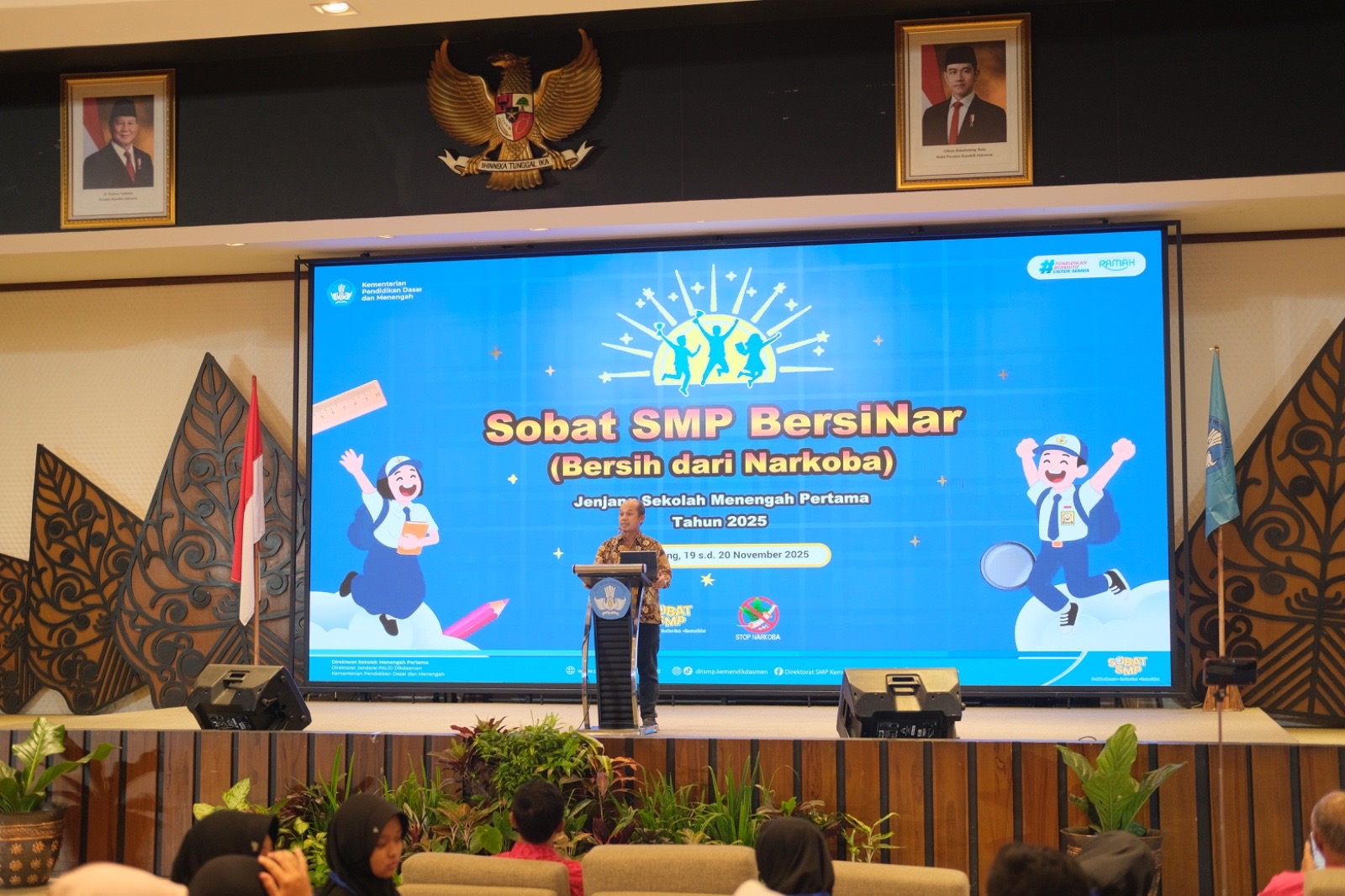
Semarang, Kemendikdasmen — The Ministry of Primary and Secondary Education (Kemendikdasmen) is promoting the strengthening of drug abuse prevention efforts among adolescents through a digital literacy approach and the use of artificial intelligence (AI). This approach is considered relevant to the characteristics of today's young generation, who live in a digital space and are vulnerable to cyberbullying and exposure to harmful content.
To that end, the Ministry of Education and Culture, through the Directorate of Junior High Schools, is holding the "Sobat SMP Bersinar" (Clean from Drugs) program. This initiative involves 60 junior high school educational institutions with support from the National Narcotics Agency (BNN), the Health Office, and UNICEF.
The Director of the Junior High School, Maulani Mega Hapsari, stated that this activity demonstrates a shared commitment to creating a safe, healthy, and drug-free educational system. She emphasized how the effort to create a drug-free school is a shared responsibility. "Collaboration is needed between schools, families, communities, and the government. Teachers play a role in building character and being role models at school. Children play a role in protecting themselves, choosing positive friendships, and being active in meaningful activities," Maulani stated separately.
Furthermore, Maulani also encouraged students to engage in positive youth activities: studying diligently, honing their talents and interests, exercising, being creative in arts and culture, and strengthening national values and mutual cooperation. "We hope that every student can become an agent of change—a pioneer in the school and community, spreading the spirit of healthy living, learning, and protecting oneself from the harmful effects of drugs," he concluded.
In his remarks at the Shining Junior High School Friends event in Semarang on Thursday (20/11), Muhammad Muchlas Rowi, Special Staff to the Minister of Primary and Secondary Education for Digital Transformation and Artificial Intelligence, said, "This activity not only provides knowledge, but also builds awareness, resilience, and commitment that we must continue to maintain together."
Citing 2024 BNN data, Muchlas revealed that drug abuse among the 15–24 age group increased from 1.44 percent in 2021 to 1.52 percent in 2023. This figure, he said, is equivalent to 312,000 Indonesian teenagers exposed to drugs, mostly triggered by curiosity, social pressure, and a low understanding of the risks.
Furthermore, Muchlas assessed that new challenges in drug prevention lie not only in the physical environment but also in the digital space. Exposure to harmful content, online bullying, and social pressure on social media have the potential to trigger risky behaviors, including substance use.
Research shows that adolescent victims of cyberbullying are more susceptible to stress, self-doubt, and even seeking escape through harmful substances. Therefore, according to Muchlas, prevention programs need to be combined with character building, mental health, and digital resilience. "Digital literacy isn't just about the ability to operate a device, but also the ability to think critically, sort information, reject hoaxes, and behave safely online," he said.
In addition to character education, he said, the use of artificial intelligence (AI) is beginning to be considered as a tool to support drug prevention in schools. He believes AI technology can help monitor drug-related keywords in digital spaces, detect patterns of online bullying, and even provide initial counseling support through chatbots.
In his report, the Student Working Team Supervisor, Harnowo, explained that the activities carried out so far were attended by elements of the education office, accompanying teachers, and hundreds of junior high school students. The mentoring was designed with an interactive method, with the main focus on practical sessions and guided group discussions (Break Out Room). The materials provided consisted of 1) SMP Bersinar friends; 2) character education and healthy living skills; 3) a conducive environment for SMP Bersinar friends; 4) building a culture of safety, comfort, and joy; and 5) SMP friends taking action and participating to Bersinar.*** (Author & Documentation: SMP Directorate Team / Editor: Stephanie)