


Jakarta, November 4, 2025 - The first day of the Academic Ability Test (TKA) for high school (SMA), vocational high school (SMK), and equivalent schools proceeded smoothly across Indonesia. This activity represents a crucial step in the government's efforts to strengthen the education assessment system, which focuses on improving the quality and equity of learning at the national level.
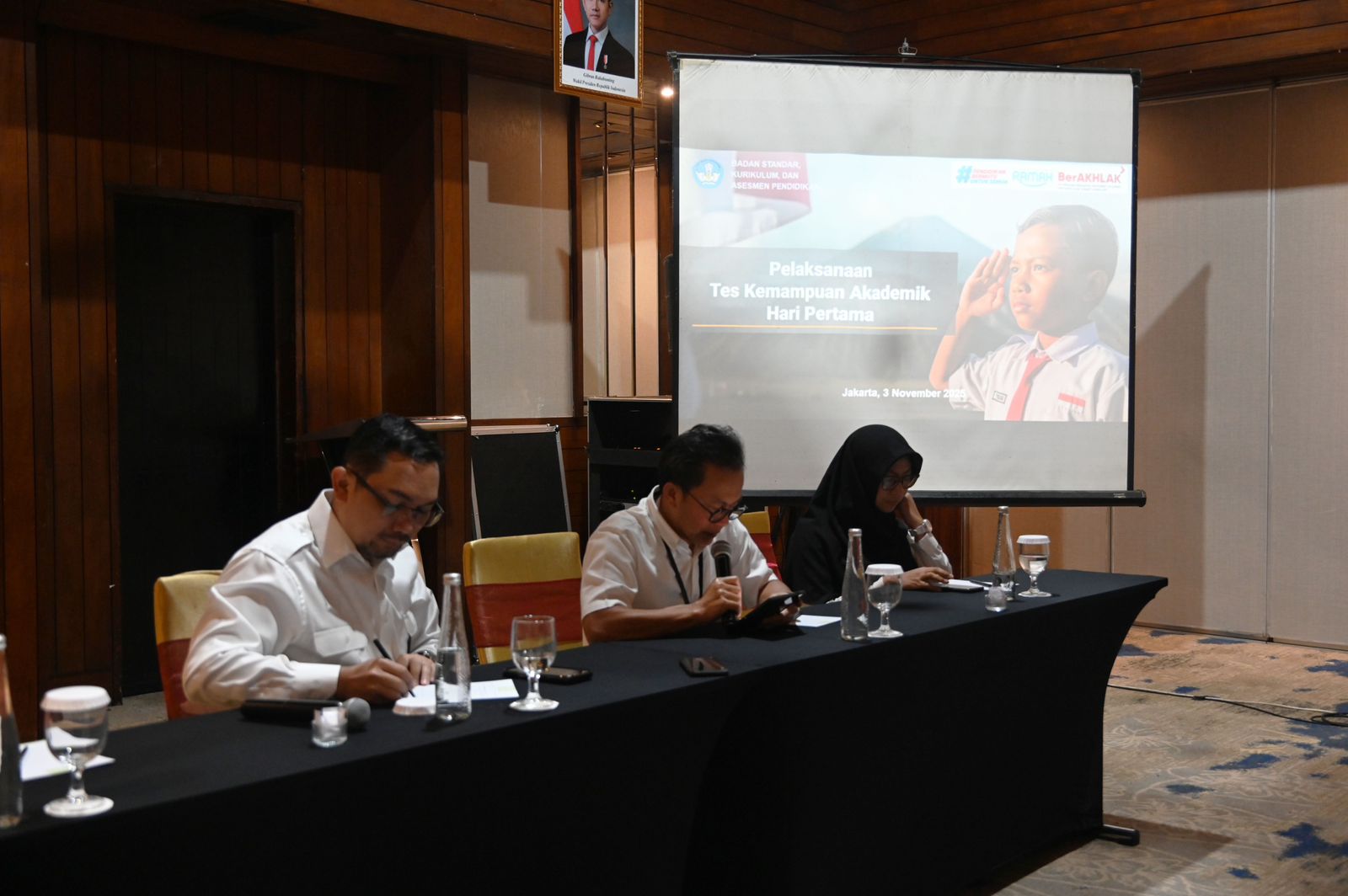
In a media briefing held in Jakarta, Monday (3/11), the Head of the Education Standards, Curriculum, and Assessment Agency (BSKAP), Toni Toharudin, expressed his appreciation to all parties who had supported the smooth running of the TKA and explained the progress of the implementation of the first day.

"We are grateful that the first day of the TKA exam went smoothly, orderly, and enthusiastically. Based on the data we collected, 1,952,683 participants, or approximately 97.9 percent of the total registered participants, took the exam on the first day," Toni said at the TKA Command Center in Jakarta on Monday (November 3), citing data as of 3:00 p.m. WIB.
Toni stated that the Ministry of Primary and Secondary Education (Kemendikdasmen) continues to strive to ensure the success of the TKA program by respecting the aspirations of all parties. He reiterated that the TKA is not mandatory and does not determine graduation.
"Graduation will be determined by the educational unit, as the educational unit is the one who knows the student's progress during their studies. After the TKA, students will continue their learning process at school according to each educational unit's policies," said Toni.
Toni further explained that the TKA serves as a nationally standardized measurement tool for individual achievement and provides an objective picture of student quality mapping across Indonesia. The TKA results are expected to inform policy improvements to improve education quality, including efforts to strengthen teacher capacity and learning relevance.
According to Toni, school participation in TKA also reflects an awareness of the importance of improving the quality of education. "When schools encourage their students to participate in TKA, the positive side is that they want to see the quality mapping, including improving the quality of teachers and graduates. Students' enthusiasm also demonstrates their concern for their own quality. Hopefully, this becomes a reality so that the acceleration of improving the quality of education can be accelerated," said Toni.
Furthermore, Toni added, "The enthusiasm of schools and students for participating in TKA demonstrates the growth of a quality culture in education. Schools can assess the quality of their students, while students can objectively assess their abilities. This is crucial so that quality improvement becomes more than just a slogan, but a work culture across all educational institutions."

Regarding the assessment infrastructure, Toni explained that the experience of administering the National Assessment over the past four years is crucial in ensuring technical readiness. Although infrastructure challenges remain in some educational institutions, these issues will serve as a basis for evaluation for future improvements.
To that end, the Ministry of Primary and Secondary Education has prepared two implementation modes: online and semi-online. In the online mode, each student's computer must be connected to the internet during the TKA implementation. Meanwhile, in the semi-online mode, student computers do not need to be connected to the internet. Schools need to prepare a server computer at school that is synchronized with the central server. During the TKA implementation, all student computers are connected to the school server without requiring an internet connection. Then, after the implementation is complete, the school server will reconnect to the central server to upload all student response data.
"This also serves as a reflection for us going forward, so that we can further complete and improve the infrastructure in educational units," he said.
Meanwhile, the Head of the Education Assessment Center, Rahmawati, added that the implementation of TKA this year still refers to the two applicable curricula, namely the 2013 Curriculum and the Independent Curriculum.

"With a significant number of applicants, more than 3.5 million students, the TKA also serves as an objective measuring tool for assessing learning outcomes based on the curriculum our students have completed," Rahmawati explained.
The first day of the TKA program marks an important first step in strengthening the national assessment system, which focuses on quality and student development. The Ministry of Primary and Secondary Education is committed to continuously improving the education system through data-driven policies, enhancing teacher competency, and fostering a culture of quality within educational institutions.*** (Author: Stephanie/Editors: Denty A., Seno H./Photographer: Irfan)

Bureau of Communication and Public Relations
Secretariat General
Ministry of Primary and Secondary Education
Website: kemendikdasmen.go.id
X: x.com/Kemdikdasmen
Instagram: instagram.com/kemendikdasmen
Facebook: facebook.com/kemendikdasmen
YouTube: Ministry of Education and Culture
Questions and Complaints: ult.kemendikdasmen.go.id
Press Release from the Ministry of Primary and Secondary Education: kemendikdasmen.go.id/pencarian/siaran-pers
#QualityEducationforAll
#MinistryofEducationAndEducationFriendly #TKAHonestAndHappy