

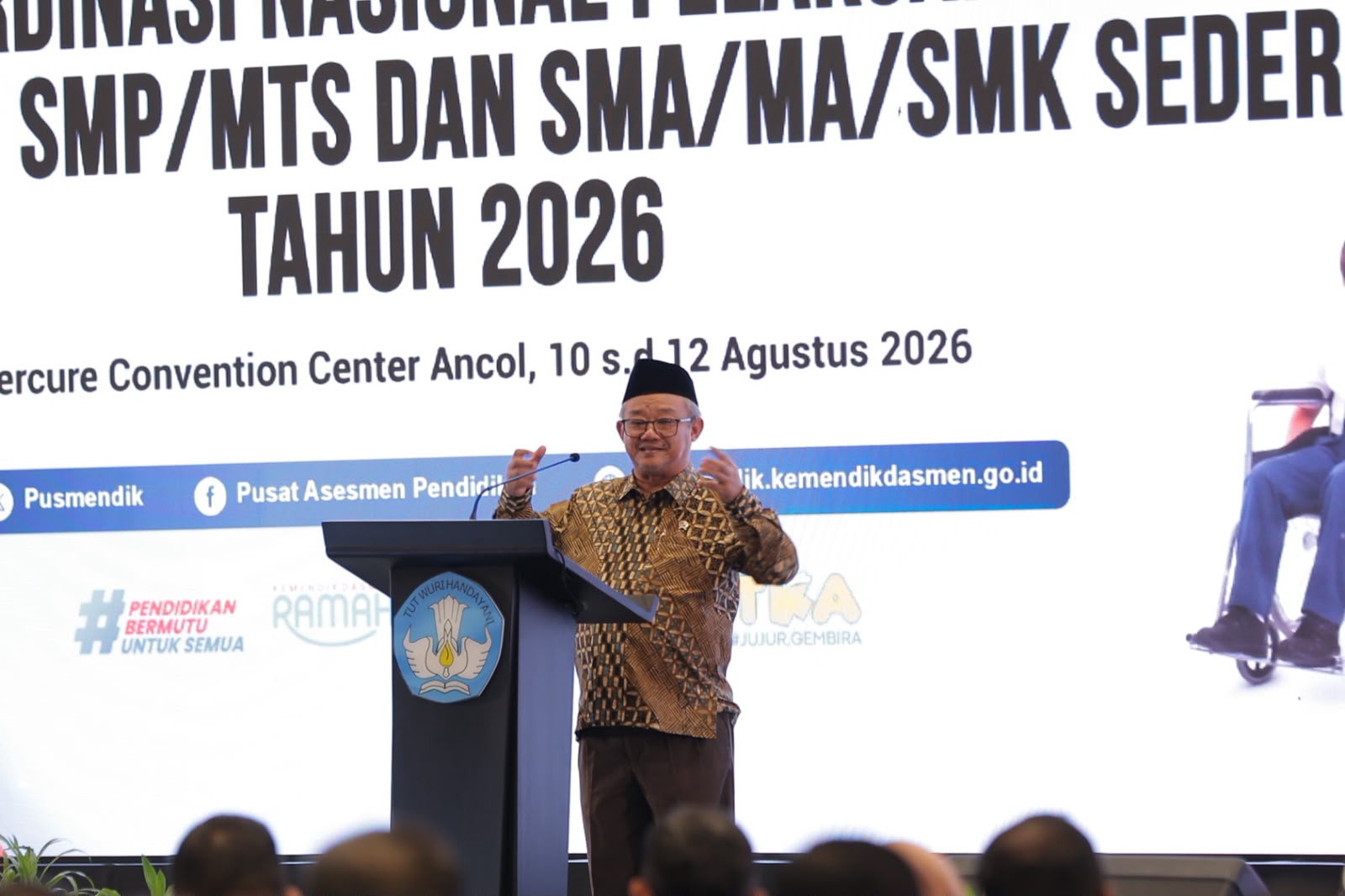
Jakarta, August 12, 2026 – The Ministry of Primary and Secondary Education (Kemendikdasmen) through the Primary and Secondary Education Policy Agency (BKPDM), continues to strengthen coordination across education stakeholders to ensure readiness for the implementation of the Academic Ability Test (TKA) in 2026. This effort was realized through the National Coordination Meeting (Rakornas) for the Implementation of TKA for Elementary Schools/Islamic Elementary Schools, Middle Schools/Islamic Junior High Schools, and High Schools/Vocational High Schools/equivalents in 2026.
In his remarks and opening remarks, Minister of Primary and Secondary Education (Mendikdasmen), Abdul Mu'ti, commended the hard work of all parties involved in successfully organizing the TKA program. He stated that the 2025 TKA program was a top-notch program and earned increasing public trust.
This trust is evident, among other things, in the increasingly widespread use of TKA results. Among other things, TKA results have become a reference for new student admissions at universities and are used in the New Student Admissions System (SPMB), particularly for the academic achievement pathway.

"TKA shouldn't be viewed solely as a number or ranking. In fact, assessment results should be used as vital information to improve the quality of learning and education," said Abdul Mu'ti at the opening of the National Coordination Meeting in Jakarta on Tuesday (August 11).
Furthermore, the Minister of Primary and Secondary Education explained the use of assessment results through the concept of assessment of learning . He stated that if the initial assessment is used to measure learning outcomes, the results should then be used as input to improve and enhance the quality of the learning process.
"TKA is an integral part of our efforts to realize Quality Education for All. TKA is not only used to measure learning outcomes; its results must be a crucial and valuable input for improving the quality of learning and education," he explained.
On the same occasion, the Head of the BKPDM, Toni Toharudin, emphasized that implementing foreign workers is a collaborative effort that requires the readiness of all parties. He stated that the success of the foreign workers is not solely determined by the implementation itself, but also depends on the quality of coordination, accurate planning, and discipline in preparing for each stage.

He explained that this National Coordination Meeting was a crucial opportunity to ensure all organizers share the same perceptions and standards. This coordination encompassed policy readiness, technology systems, participant data collection, infrastructure, implementation mechanisms, oversight, and public communication strategies.
Furthermore, Toni views this National Coordination Meeting as an important step in harmonizing the utilization of the results of the 2026 Elementary and Middle School TKA. It is hoped that the TKA results can be utilized by education stakeholders as a source of information for evaluating and improving learning.
"Through this National Coordination Meeting, we hope to foster open discussions, identify potential risks, and develop solutions together. By preparing more mature foreign workers, we hope the 2026 foreign workers will proceed smoothly, provide the best assessment services for all students, and be celebrated with honesty and joy," Toni concluded.*** (Author: Destian/Photographer: Ministry of Primary and Secondary Education Team)
Bureau of Communication and Public Relations
Secretariat General
Ministry of Primary and Secondary Education
Website: kemendikdasmen.go.id
X: x.com/Kemdikdasmen
Instagram: instagram.com/kemendikdasmen
Facebook: facebook.com/kemendikdasmen
YouTube: Ministry of Education and Culture
Questions and Complaints: ult.kemendikdasmen.go.id
Press Release from the Ministry of Primary and Secondary Education: kemendikdasmen.go.id/pencarian/siaran-pers
#QualityEducationforAll
#MinistryofEducationAndEducationFriendly