

Jakarta, August 19, 2026 – The Ministry of Primary and Secondary Education (Kemendikdasmen) expresses its deepest condolences for the disaster in East Nusa Tenggara (NTT). This disaster has had a significant impact on the community, especially schoolchildren. In response to this situation, Kemendikdasmen continues to ensure that students' right to learn is met according to conditions on the ground.
The Minister of Primary and Secondary Education (Mendikdasmen), Abdul Mu'ti, emphasized that the continuity of learning in affected areas needs to be adjusted to the conditions faced by educational units.
"The Ministry of Primary and Secondary Education's priority and commitment is the safety of teachers and students in disaster areas. Therefore, the learning process also takes their safety into account. One way is by using an emergency learning system with an emergency curriculum," said the Minister of Primary and Secondary Education in Jakarta on Wednesday (August 19).
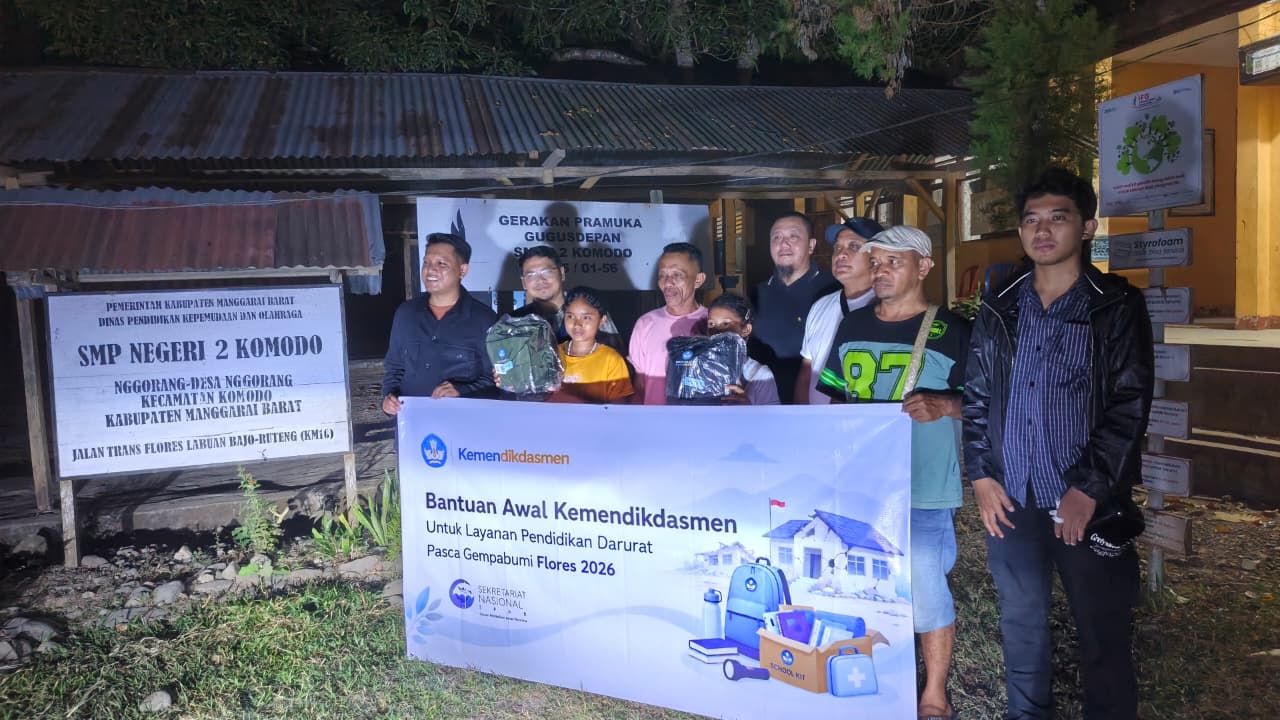
The Minister of Primary and Secondary Education added that aid and support for the learning process has been distributed to several disaster-affected areas. In Labuan Bajo, a team bringing aid to support the continuity of learning for affected school residents has arrived.
"The Ministry of Elementary and Secondary Education team that has arrived in Labuan Bajo has brought aid containing 2,000 children's gift packages, 800 school kits , and 70 family kits to support learning during the emergency," the Minister of Elementary and Secondary Education added.
Based on data from the Disaster-Safe Education Units (SPAB), as of August 19, 2026, the disaster affected 512 educational units in seven districts, 94,452 students, and 8,755 teachers and other education personnel. Of these, 52,268 students in 276 educational units were forced to close. For the time being, learning is being conducted at home and in evacuation centers.
Learning Guide in Emergency Times
In addition, the Ministry of Education and Culture, through the Primary and Secondary Education Policy Agency (BKPDM), continues to ensure that students' learning rights are fulfilled in disaster situations, which is realized by providing learning guides for disaster-affected educational units to maintain the continuity of learning in emergency conditions.

The Head of the National Education and Culture Agency (BKPDM), Toni Toharudin, emphasized that the Ministry of Education and Culture continues to focus on the education units, students, and teachers affected by the disaster in NTT. "We are ensuring that they continue to receive support so that the learning process can continue and students' rights to learn are fulfilled, despite the limitations. Our presence and support for the affected school community is part of our commitment to ensuring education continues under any circumstances," he said.
This guide has been developed taking into account the conditions and needs of educational institutions affected by disasters. Learning does not have to follow the same pattern as under normal conditions. Educational institutions are given the freedom to adapt their learning process based on the level of damage, the availability of facilities and infrastructure, the condition of students and teachers, and the surrounding environment.
In its implementation, educational units can prioritize learning materials that are essential and relevant to students' circumstances. Psychosocial support, personal safety, basic literacy and numeracy, and restoring learning routines are all important aspects that require attention. Learning methods can also be adapted, including limited face-to-face learning, independent learning, or other methods that are feasible and appropriate to the conditions and available resources.
In addition to academic aspects, this guide also places psychosocial aspects as a crucial part of the recovery process. Disasters can have an emotional impact on students, teachers, and education personnel. Therefore, the school environment is expected to return to being a safe space that supports recovery, builds self-confidence, and helps the school community gradually return to learning activities.
To support implementation in the field, the Ministry of Primary and Secondary Education also provides learning examples that can inspire educational institutions in designing learning activities appropriate to post-disaster conditions. These examples and supporting materials are accessible to the public through the Rumah Pendidikan website.
The Ministry of Education and Culture invites local governments, education offices, school principals, teachers, and all education stakeholders in NTT to work together to ensure learning continues while prioritizing safety, flexibility, and student needs. Collaboration among all parties is necessary to ensure that disasters do not hinder children's right to education.*** (Author: Ririn & BKPDM Team/Documentation: Ministry of Education and Culture Team)
Bureau of Communication and Public Relations
Secretariat General
Ministry of Primary and Secondary Education
Website: kemendikdasmen.go.id
X: x.com/Kemdikdasmen
Instagram: instagram.com/kemendikdasmen
Facebook: facebook.com/kemendikdasmen
YouTube: Ministry of Education and Culture
Questions and Complaints: ult.kemendikdasmen.go.id
Press Release from the Ministry of Primary and Secondary Education: kemendikdasmen.go.id/pencarian/siaran-pers
#QualityEducationforAll
#MinistryofEducationAndEducationFriendly