

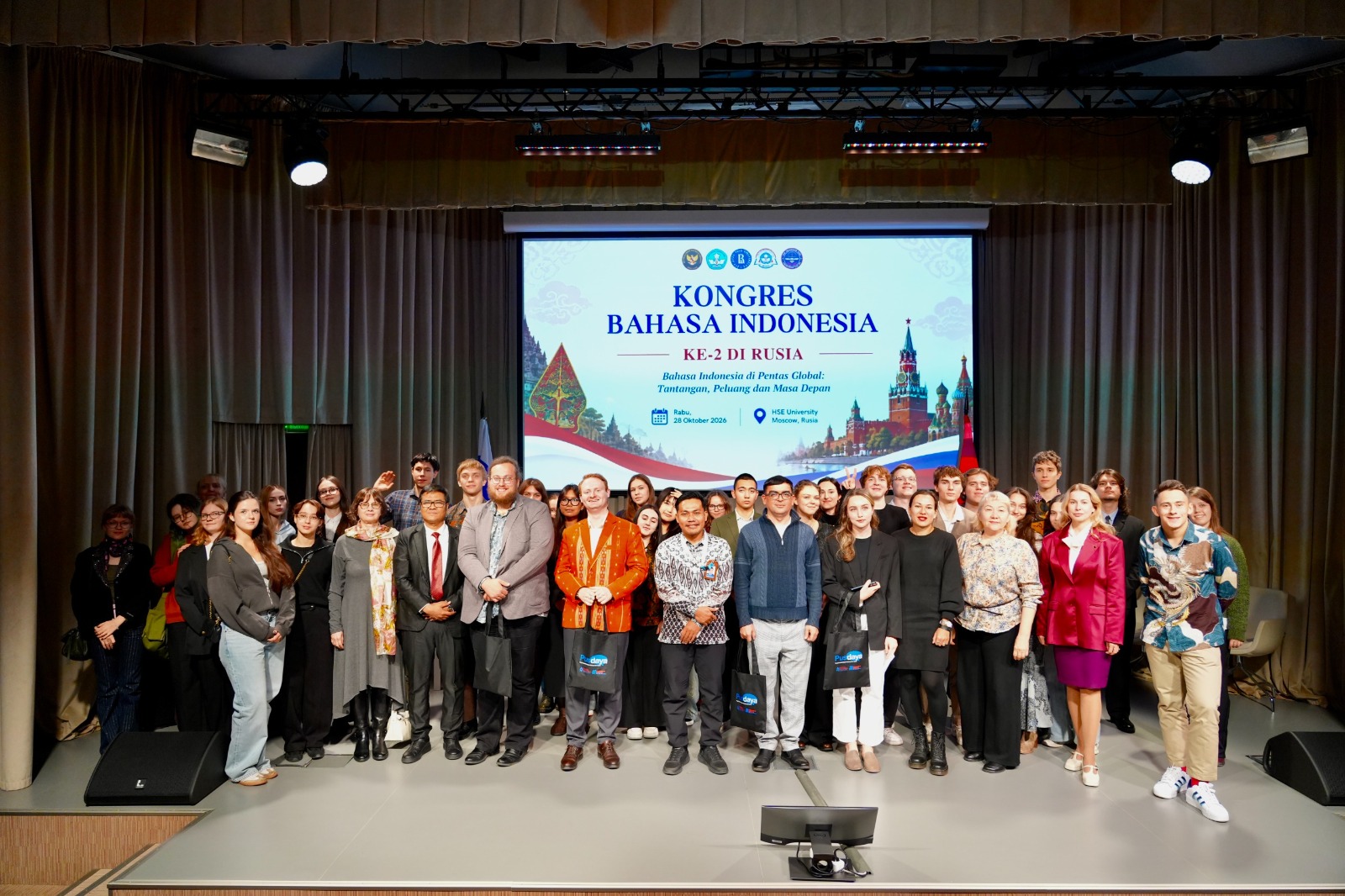
Moscow, November 1, 2026 - Indonesian, declared a unifying language 98 years ago, is now being studied by young people in Russia. In Moscow, around 140 students, academics, teachers, and Indonesianists gathered for the Indonesian Language Congress at the Higher School of Economics University (HSE University) on Wednesday (October 28).
This meeting is part of the Ministry of Primary and Secondary Education's (Kemendikdasmen) efforts to make Indonesian more widely known and used worldwide.
For Deputy Minister of Primary and Secondary Education, Atip Latipulhayat, introducing Indonesian to the global community isn't just about teaching them vocabulary and grammar. Indonesian must also be present in academic conversations, diplomacy, trade, and international culture.

"Internationalizing Indonesian is not merely an effort to increase the number of people studying Indonesian, but also an effort to improve the function, dignity, and usefulness of Indonesian in the lives of global society," he said at the congress themed "Indonesian on the Global Stage: Challenges, Opportunities, and the Future."
The recognition of Indonesian as one of the official languages of the UNESCO General Assembly on November 20, 2023, is a significant milestone. However, the next task is much larger: ensuring that Indonesian is not only recognized but also used in various forums and activities globally.
The government has developed a Roadmap for the Internationalization of the Indonesian Language for 2025–2045. The Indonesian Language Internationalization Index (IPBI) increased from 51.44 in 2024 to 52.99 in 2025, with a target of 55.87 by 2029.
One entry point is the Indonesian Language for Foreign Speakers (BIPA) program. As of October 2026, BIPA had reached 62 countries through 520 institutions with over 234,000 active learners. In Russia, the program has found a place through the Indonesian Embassy in Moscow's BIPA class, which currently has 149 students.
Deputy Minister Atip assessed that Russia has great potential as a partner in Indonesian language development. Russia's academic tradition in language, literature, and cultural studies can serve as a foundation for expanding student and academic exchanges, joint research, the Indonesian Language and Literature (BIPA) program, and literary translation.
"Indonesian is the identity of the Indonesian nation, but Indonesian is also a bridge of friendship for the world community," he said.
Indonesian is certainly not new to Russia. The Indonesian Ambassador to the Russian Federation, Jose Tavares, stated that its teaching at Moscow State University began in the late 1950s. Now, Indonesian is also studied at HSE University.
Despite its long history, Indonesian language teaching in Russia still faces several challenges. The number of teachers is limited, teaching materials tailored to Russian speakers are scarce, and program sustainability requires attention. Jose hopes this congress will produce concrete recommendations to address these issues and expand the network of Indonesianists in Russia and Belarus.
Khoirul Rosyadi, the Education and Cultural Attaché of the Indonesian Embassy in Moscow, stated that the congress would continue as an annual event. This second edition also brought together Russian Indonesianists from various generations, from those who have long studied Indonesian studies to students currently studying it.
Outside the discussion room, the BIPA book exhibition introduced Indonesian language learning materials to participants. The atmosphere became even more lively when Veronika Khomkina and Anastasia Marker performed the song "Karena Kamu" and the keroncong song "Sapu Tangan."
From Moscow classrooms to international forums, the Indonesian language is on a different journey than it was 98 years ago. While once a pledge to unite the various ethnic groups of the archipelago, it now offers the world a chance to learn more about Indonesia.*** (Author and Documentation: Language Agency Team and Indonesian Embassy Team in Moscow/Editor: Uly, Seno H.)

Bureau of Communication and Public Relations
Secretariat General
Ministry of Primary and Secondary Education
Website: kemendikdasmen.go.id
X: x.com/Kemdikdasmen
Instagram: instagram.com/kemendikdasmen
Facebook: facebook.com/kemendikdasmen
YouTube: Ministry of Education and Culture
Questions and Complaints: ult.kemdikdasmen.go.id
Press Release from the Ministry of Education and Culture: kemdikdasmen.go.id/main/blog/category/siaran-pers
#QualityEducationforAll
#MinistryofEducationAndEducationFriendly
#2YearsOfRealMotion
#2YearsOfQualityEducation