


Medan, Ministry of Education and Culture – Education is the spearhead in creating the Golden Indonesia generation in 2045. In the process, education is not only focused on producing human resources (HR) who are intellectually intelligent, but must also have a strong and competitive character.
Arif Jamali, Special Staff to the Minister of Primary and Secondary Education for Learning and Excellent Schools, stated that quality education includes character education. Character education is crucial in preparing Indonesian children to face the challenges of the times.
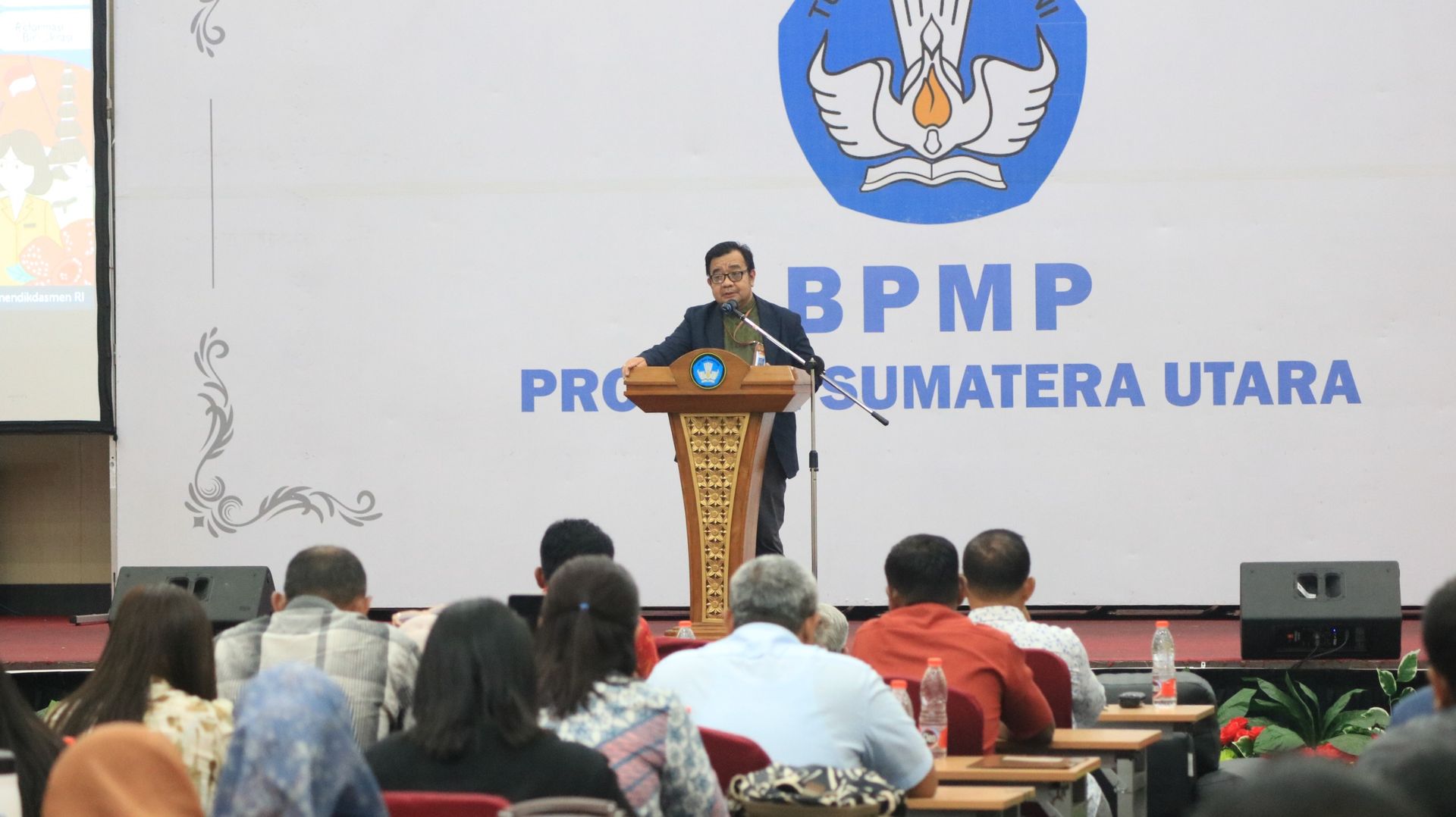
"The challenges ahead will be far greater than today. We cannot predict cultural shifts, technological advancements, and the mindsets of our children. Therefore, character education is a key pillar in shaping Indonesian children into a resilient generation," he said at the opening of the 2025 Character Strengthening Policy Facilitation and Advocacy event at the North Sumatra Provincial Education Quality Assurance Center in Medan on Monday (September 15).
Arif explained that character education should be implemented in two ways, namely by integrating it into learning and by implementing co-curricular activities that support the learning process.
According to him, the Ministry of Primary and Secondary Education (Kemendikdasmen) has developed in- depth learning, which also includes character education. "The character education within in-depth learning isn't just about transferring knowledge, but also about meaningfulness. Children need to know that what they're learning is beneficial for their lives," he said.
Furthermore, character education must be conscious and joyful. "Joyful means how teachers can create a learning environment that builds children's motivation and enthusiasm for learning," Arif added.
Furthermore, Arif said that character education carried out through co-curricular activities can be realized in three forms, namely cross-subject projects, implementation of the Seven Habits of Great Indonesian Children Movement (G7KAIH), and programs tailored to the specific characteristics of each educational unit.
Shared Responsibility
However, Arif emphasized that character education is not solely the responsibility of educational institutions; all stakeholders play a crucial role. In this regard, the Four Pillars of Education include families, educational institutions, communities, and the media.
"Character education cannot be left to educational institutions alone; it is a shared responsibility. The ultimate goal is to develop strong character in our children. I hope that our activities today will enable G7KAIH to become a major program of the North Sumatra Education Office. We will evaluate its impact going forward," he explained.
On the same occasion, the principal of SMP Negeri 1 Medan, Rohanim, stated that the implementation of G7KAIH in the school had had a positive impact on students. This was evident, among other things, in the decrease in the number of students arriving late to school.
"The number of children who used to be late is decreasing. We asked the parents because they (the children) are now going to bed earlier and no longer playing with gadgets at night. This has become a good habit for the children in G7KAIH: going to bed early," said Rohanim.
He also stated that the successful implementation of G7KAIH also requires the role of parents, especially in guiding and accustoming children to it from home. This includes not only initialing the daily journal, but also ensuring that children instill character values through the practice of 7KAIH.
Echoing Rohanim, M. Basir Hasibuan, Head of the High School Development Division at the North Sumatra Education Office, emphasized the importance of cross-sectoral collaboration in the implementation of G7KAIH. He expressed his hope that G7KAIH would be implemented across all educational institutions and, above all, become a positive habit for students.
"Following this activity, we at the Education Office will issue a circular following up on the Circular of the Minister of Primary and Secondary Education regarding the G7KAIH Habit and a mechanism to monitor its implementation to see whether it has been running well in educational units or not," he concluded.
The 2025 Character Strengthening Policy Facilitation and Advocacy Activity held at the North Sumatra Province Education Quality Assurance Center was attended by representatives from various parties, including the Provincial and Regency/City Education Offices in North Sumatra, the Principals' Working Conference (MKKS) and the School Committees of Senior High Schools, Vocational High Schools, Special Needs Schools, Parenting Communities, Religious Organizations, the Indonesian Kindergarten Teachers Association (IGTKI), the Association of Indonesian Early Childhood Educators and Education Personnel (HIMPAUDI), and also the media as part of the four centers of education.*** (Author: Puspeka Team, Rayhan/Editor: Denty A., Seno H./Documentation: Puspeka)